How can one Y-shaped protein design recognize billions of targets?
Your body doesn't need to guess which germ will attack next: it is estimated to make about 10 billion different antibodies, each able to grab a different target.
▶ Start the storyAntibodies are Y-shaped proteins that patrol your blood and tissues, and at the tip of each branch sits a paratope, a tiny lock shaped to fit one specific part of a germ, called an epitope. A paratope only fits its one epitope, the way one key fits one lock. The trick is that your body doesn't rely on a single master key: it manufactures roughly 10 billion different antibodies, each with a slightly different tip, so that whichever new germ shows up, some lock in that enormous keyring already happens to fit.
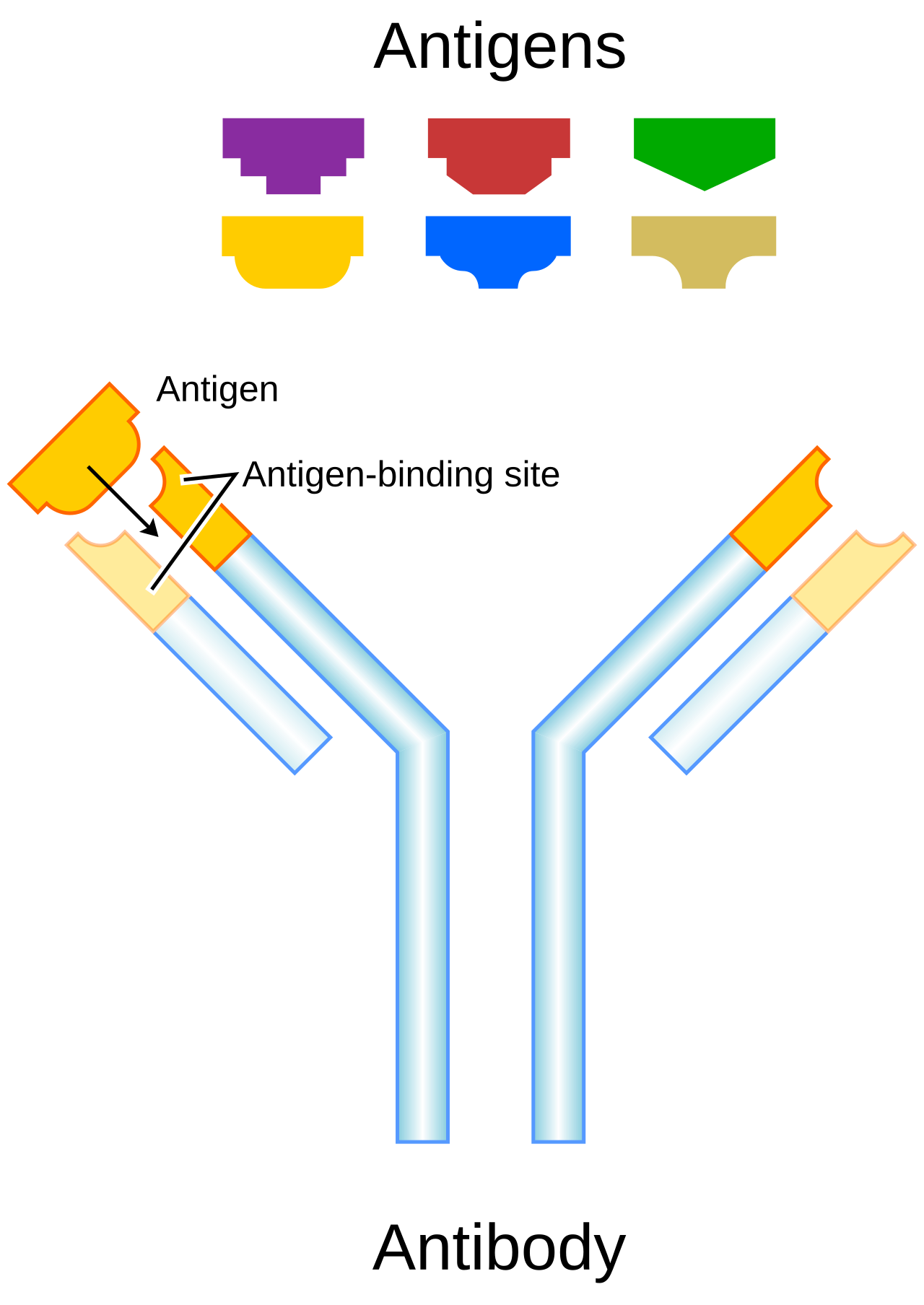
That idea took a strange route to being understood. In 1890, Emil von Behring and Kitasato Shibasaburo described antibody activity against diphtheria and tetanus toxins, and proposed that something in blood serum could react with a foreign invader, before anyone knew what, exactly, that something was. A year later, the German scientist Paul Ehrlich gave the mystery substance a name, writing that if two different substances provoke two different "Antikörper", the substances themselves must be different in kind. It took another fifty years, and the chemist Linus Pauling, to confirm the lock-and-key theory Ehrlich had proposed: whether an antibody binds its target depends more on shape than on chemical composition.
Antibodies come in five varieties, named IgA, IgD, IgE, IgG and IgM, which differ in the jobs they trigger and in where in the body they are released. Together they make up what's called humoral immunity, meaning immunity carried by soluble proteins in the body's fluids, as distinct from T cells attacking infected cells.
Quiz me
0/3
Recap
Antibodies work like a vast keyring: one key per lock, billions of keys, so a fit is likely to exist for almost any lock that shows up.
Surprising fact · The body is estimated to generate roughly 10 billion different antibodies, each able to bind a distinct target.
Sources (1)
No source, no claim. Every fact in this lesson (16 claims) cites at least one of these.