How can a bugle play a tune with no valves or keys?
A bugle is just a bent tube, yet it plays every military call. The notes were hiding inside a single vibrating column of air.
▶ Start the storyA bugle plays tunes by jumping between the natural harmonics of its tube. Any column of air, like any string, vibrates at many frequencies at once: a lowest one, the fundamental, plus higher ones at exactly two, three, four, five times that frequency. That ladder of whole-number multiples is the harmonic series. A bugle has no valves, so it cannot change the length of its tube; instead the bugler changes the air and the tension of the lips, and the tube 'locks on' to a different rung of the ladder.
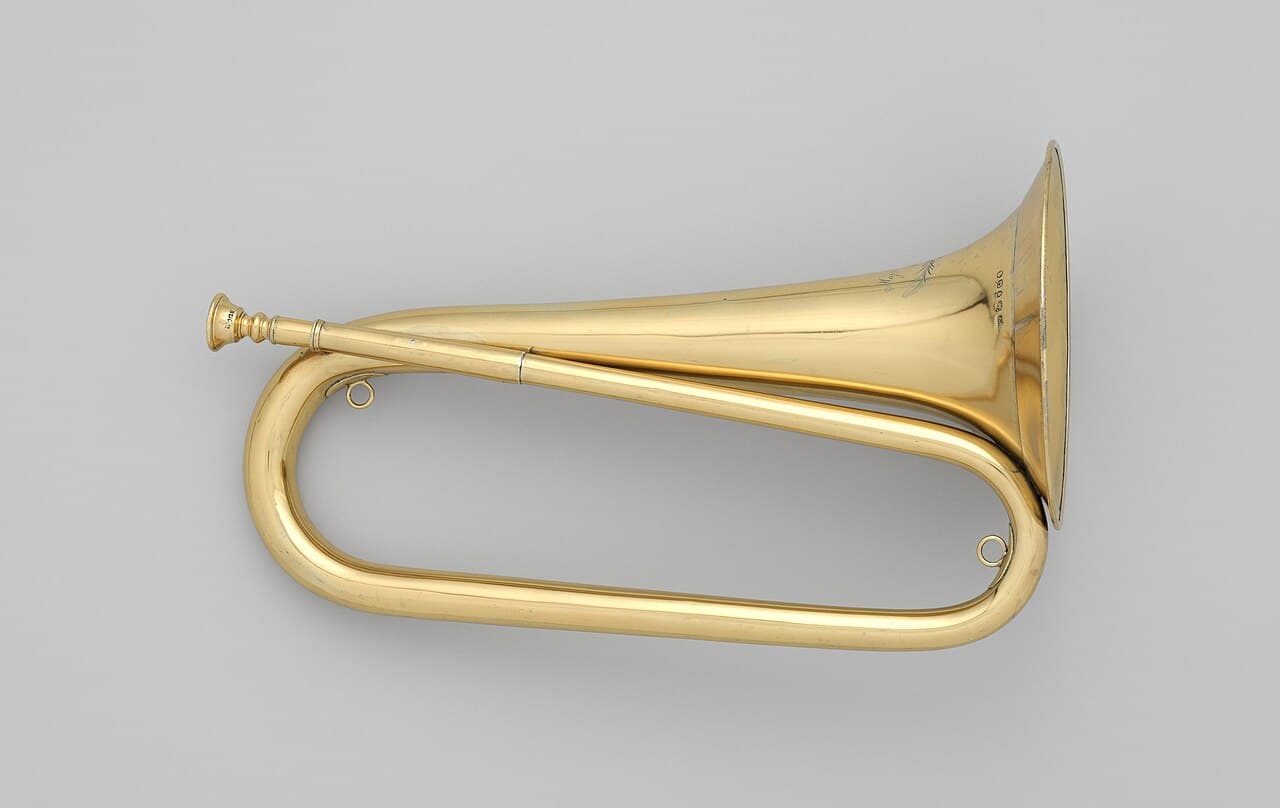
The rungs are musical. The second harmonic sounds an octave above the fundamental, the third a fifth above that, the fourth two octaves above the fundamental. A bugle normally uses only the second to sixth harmonics, which happen to spell a major chord, for instance B♭, D and F. That is why every bugle call, from reveille to Taps, sounds like a broken chord: by definition, a bugle call uses notes from a single overtone series and nothing else.
Soldiers lived by those few notes. Every duty in camp had its own call, and the cavalry, with horses to look after, heard twice as many signals as the infantry. Taps, built from the same handful of harmonics, still marks the end of the day and is sounded at military funerals.
Quiz me
0/3
Recap
Fundamental, then 2×, 3×, 4×: an octave, a fifth, another fourth, and the higher rungs crowd closer together.
Surprising fact · Some harmonics, notably the 7th and 11th, are out of tune with Western scales, so Baroque trumpeters bent them with their lips and Tuvan singers skip them.
Connects to
- 〰️ How did a theory about heat end up taking music apart?
- 🎻 Why does a violin sound different from a flute playing the same note?
- 🎹 Why is every modern piano tuned slightly out of tune on purpose?
- 🔢 Why does Western music have exactly 12 notes?
- 🎹 Why do two notes an octave apart sound like the same note?
Sources (5)
No source, no claim. Every fact in this lesson (19 claims) cites at least one of these.