Did Sherlock Holmes invent forensic science?
Holmes is the only fictional character ever made an honorary fellow of the Royal Society of Chemistry.
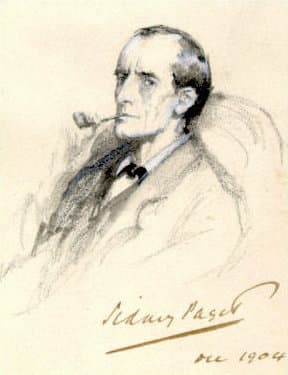
▶ Start the storyNo, but he made it famous and inspired the people who built it. Holmes, the detective Arthur Conan Doyle created in 1887, solves crimes with hard evidence: footprints, tobacco ash, handwriting, gunpowder residue, a microscope and a home chemistry lab. Many of those techniques were in their infancy at the time. Yet the historian Laura J. Snyder showed that Holmes's methods, while sometimes ahead of what police were using, were based on techniques that already existed.
The fingerprint is a good example. Holmes solves a case with a thumbprint in "The Norwood Builder", but that story was published in 1903, two years after Scotland Yard had opened its fingerprint bureau. Sometimes, though, the fiction did run ahead: in "The Empty House", Holmes matches bullets to a weapon, a practice that became regular police procedure only about fifteen years later.
Holmes himself had a real-life model. Conan Doyle said he was inspired by Joseph Bell, an Edinburgh surgeon he had worked for. Bell taught medical students to "observe carefully, deduce shrewdly, and confirm with evidence", and liked to read strangers at a glance: from red clay on a woman's shoes and a rash on her hand, he worked out where she had walked and where she worked. Bell is considered a pioneer of forensic science himself. Modestly, he wrote to Doyle: "You are yourself Sherlock Holmes."
The effect of the stories on forensic science has often been overstated, but Holmes inspired generations of forensic scientists to think scientifically. One of them, the French pioneer Edmond Locard, became known as the "Sherlock Holmes of France".
Quiz me
0/3
Recap
Holmes's methods were mostly based on existing techniques, but the stories turned forensic science into a hero's toolkit.
Surprising fact · Holmes was modelled on Joseph Bell, an Edinburgh surgeon who could deduce a stranger's job from her shoes and hands.
Connects to
- 🌧️ What kind of logic guesses the best explanation?
- 👆 Did a novelist use fingerprints as evidence before the police did?
- 📖 Why are Victorian novels so enormously long?
- Forensic science
- Locards exchange principle
Sources (3)
No source, no claim. Every fact in this lesson (18 claims) cites at least one of these.