Why do time zones zigzag instead of following straight lines?
In theory the world splits into 24 neat slices of 15°; in practice, China runs on one clock and in western Spain the summer sun peaks at 14:41.
▶ Start the storyTime zones zigzag because they follow countries, trade and history, not just the Sun. In theory, the idea is simple: the Sun's noon moves four minutes later for every degree of longitude, so you could slice the globe into 24 zones of 15 degrees each, as Sandford Fleming proposed in 1876. In practice, governments bend the lines to keep a country, a market or a railway network on the same clock.
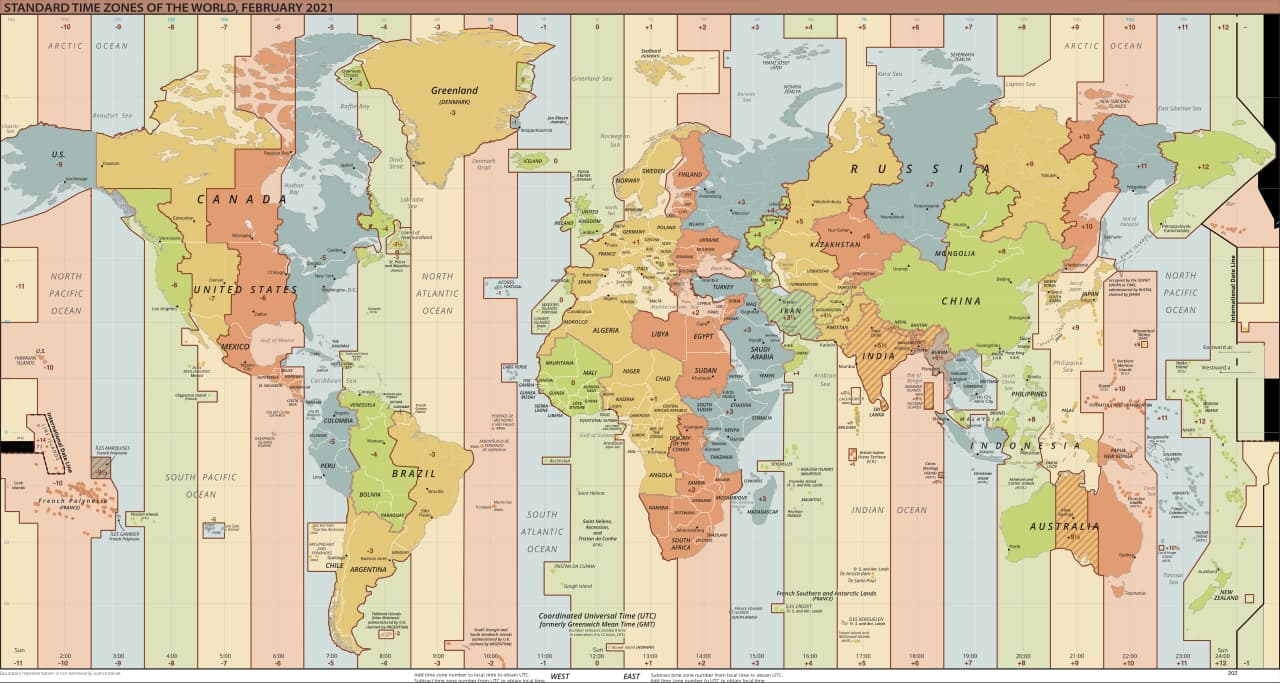
Time zones were born on the railways. Before them, every town kept its own solar time, and in North America some stations had a separate clock for each railroad, each showing a different time, which led to accidents. On 18 November 1883, the Day of Two Noons, American station clocks were reset to a few standard zones.
Since then, politics has pulled the lines around. The Prime Meridian passes through Spain and France, yet both use Central European Time. France switched during the German occupation in World War II and never switched back. As a result, in western Spain the summer sun reaches its highest point at 14:41 on the clock. China goes further: it spans five geographical time zones but uses a single clock, set to Beijing. In the far west, in Xinjiang, the Sun can peak as late as 15:00. And on the border between Afghanistan and China, clocks jump by three and a half hours.
So a time zone map is really a political map, drawn in hours.
Quiz me
0/3
Recap
The Sun sets the theory, four minutes per degree; people set the borders.
Surprising fact · China spans five geographical time zones but uses a single clock, so the Sun can peak at 15:00 in Xinjiang.
Sources (3)
No source, no claim. Every fact in this lesson (16 claims) cites at least one of these.