Why do soap molecules clump into tiny balls in water?
At very low concentrations, soap molecules drift around alone. Add more and, past a threshold, they start packing themselves into tiny balls.
▶ Start the storyBecause, past a certain concentration, clumping together frees up the surrounding water. A soap molecule is a surfactant: a water-loving head attached to a water-fearing tail. On its own, each tail sits inside a cage of water molecules held together by hydrogen bonds, with an ice-like structure. Once the soap passes a threshold called the critical micelle concentration, it pays for the tails to huddle: clustering them is unfavorable in itself, but releasing all those water cages gains more entropy. The result is a micelle, a roughly spherical cluster with the heads facing the water and the tails forming an oily core.
People knew for centuries that soapy water cleans, yet nobody studied what was actually in it until the early twentieth century. In 1913, James William McBain at the University of Bristol proposed the existence of 'colloidal ions' to explain why solutions of sodium palmitate, a soap, conducted electricity so well. These spontaneously formed, highly mobile clusters came to be called micelles, a nineteenth-century word built from the Latin mica, 'particle', to mean 'tiny particle'.
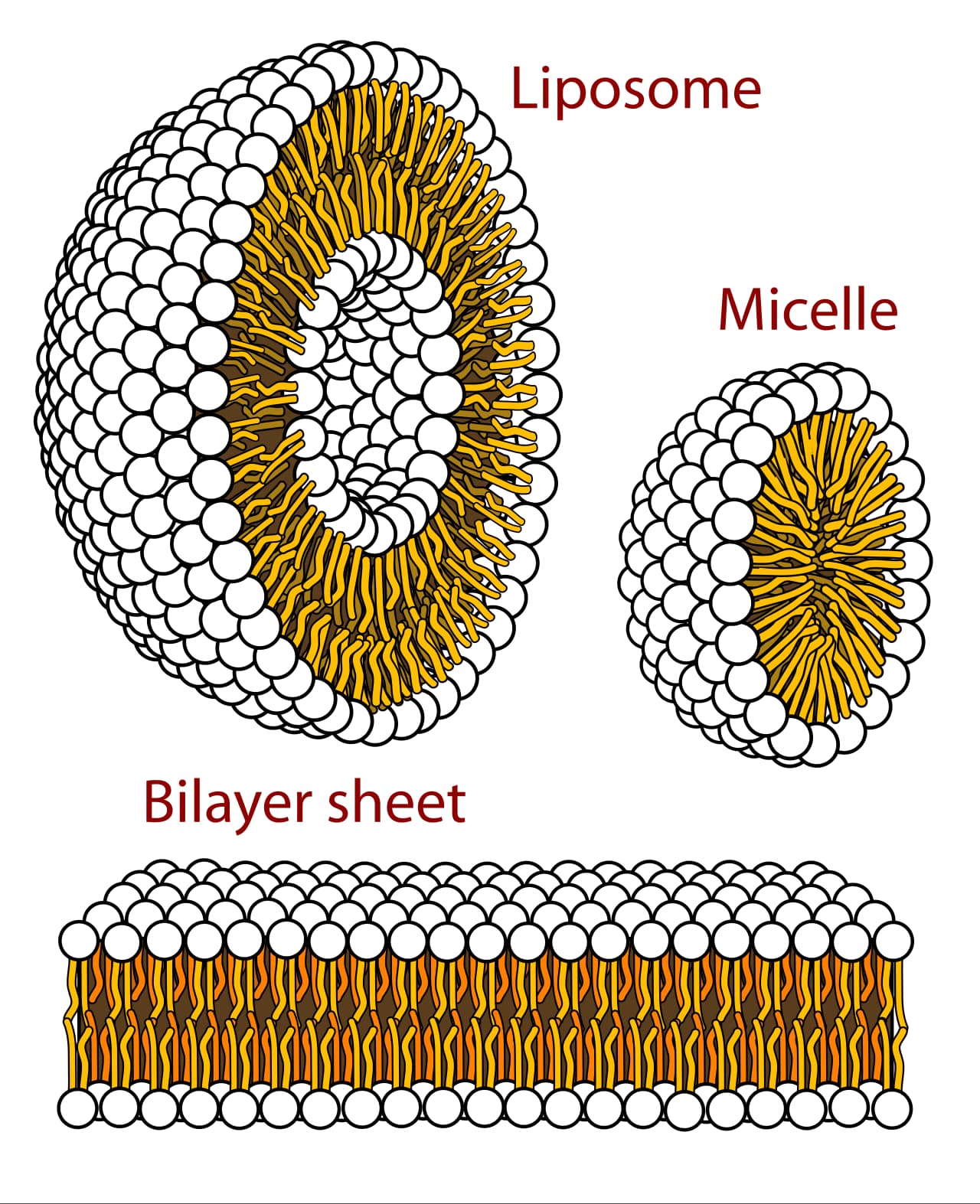
That oily core is what makes soap a cleaner. Greasy dirt that won't dissolve in water ends up inside micelles, where the soap's water-loving heads shield it from the water, and then it can be washed away. Conditions matter as well: micelles only form above a temperature called the Krafft temperature, and their shape and size shift with concentration, temperature, pH and dissolved salts.
Turn the setting inside out and the trick flips. In an oily, non-polar liquid, surfactants form inverse micelles, with the water-loving heads tucked into the core and the tails pointing outward. Chemists have also built sturdier micelles from block copolymers; these kinetically frozen micelles survive dilution, which makes them interesting for developing drug-carrying nanoparticles that circulate for a long time.
Quiz me
0/3
Recap
Past the critical micelle concentration, soap molecules hide their tails together in micelles, and grease can hide in that oily core too.
Surprising fact · The tails clump together mainly because doing so releases the ice-like cages of water molecules that surrounded each one, a net gain in entropy.
Sources (2)
No source, no claim. Every fact in this lesson (12 claims) cites at least one of these.