Why do English and French share so many words?
For about three centuries after 1066, England's kings, courts and lawyers spoke French, and English never gave the words back.
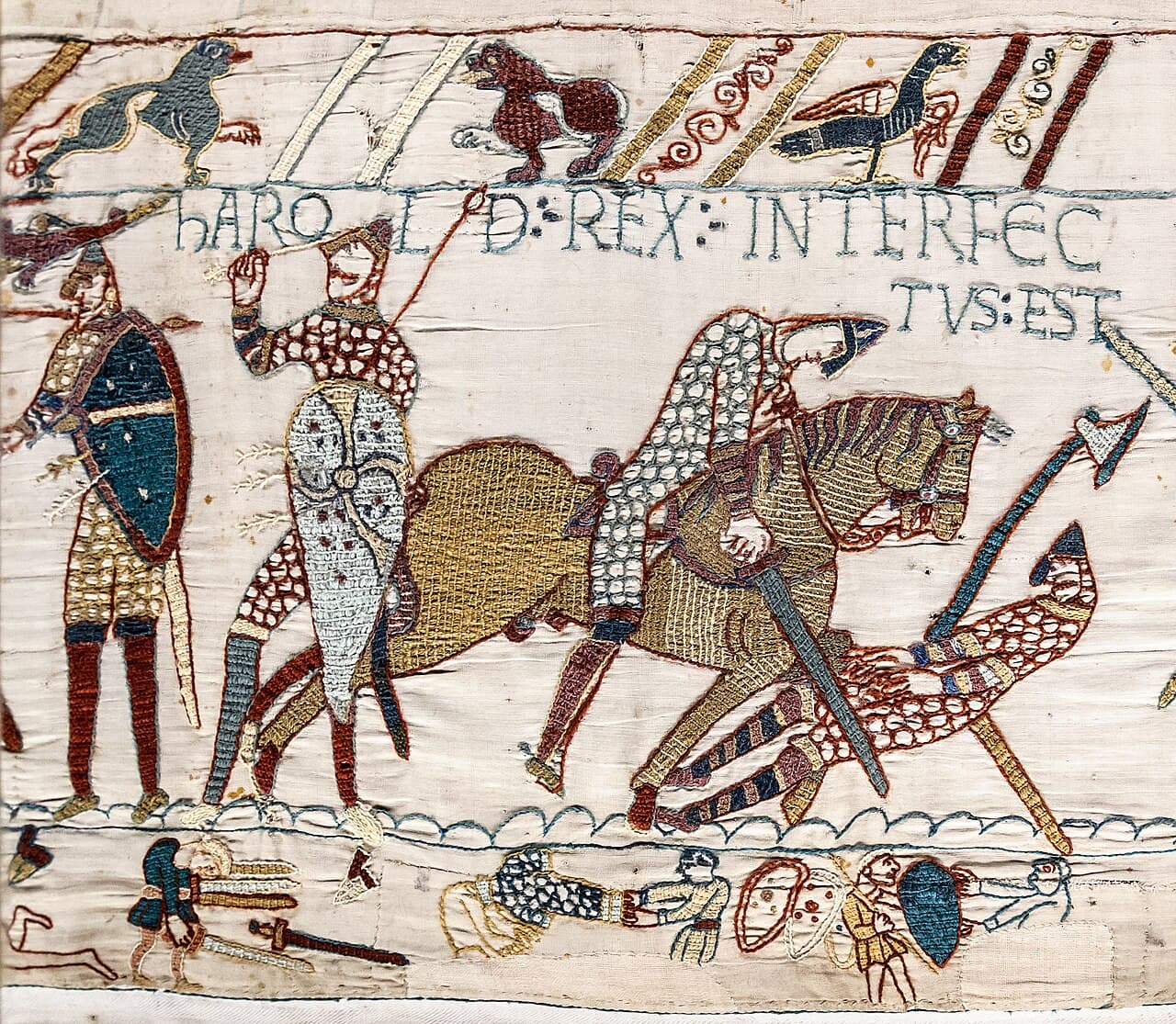
▶ Start the storyEnglish and French share so many words mainly because, after the Norman Conquest of 1066, French became the language of England's rulers for centuries. William of Normandy, Guillaume le Conquérant, took the English throne, and his Norman French replaced English at court, among the aristocracy, in the law courts and in the Church. Ordinary people kept speaking English, but anyone dealing with power had to use French words.
Those words stayed. Estimates of the share of English vocabulary that comes from French range from a third to two thirds, and law alone gave English justice, crime, jury, pardon, arrest and evidence. The peak came between 1250 and 1400, when 40% of all the French words in English first appear. Even word-building pieces crossed the Channel: suffixes like -tion, -ment and -able.
There are fun oddities. Some words were borrowed twice, once from Norman and once from Parisian French, which is why English has both catch and chase, warranty and guarantee. And beware of a famous story: that English peasants raised cows, sheep and pigs while French-speaking nobles ate beef, mutton and pork. Walter Scott popularized it in Ivanhoe, but the French food words appeared around 1300 and long named both the animal and its meat. The neat split came centuries later.
1066
Norman Conquest: French becomes the language of power
1250–1400
Peak borrowing: 40% of French words in English appear
1349
Oxford starts teaching in English
1819
Ivanhoe spreads the 'beef and cow' myth
Quiz me
0/3
Recap
1066 put French at the top of English society, and its words trickled down and never left.
Surprising fact · Some French words were borrowed twice, giving English pairs like catch and chase.
Connects to
- 🍵 Why does nearly every word for tea sound like "tea" or "cha"?
- 🔤 Why is English spelling so weird?
- Norman conquest
- Anglo norman language
- Hundred years war
Sources (1)
No source, no claim. Every fact in this lesson (16 claims) cites at least one of these.