Why do some artists get a cut when their painting is resold for a fortune?
A French farm scene sold for 553,000 francs in an 1889 bidding war while the painter's family lived in poverty. A new French right followed.
▶ Start the storyIn some countries, artists or their heirs are legally entitled to a fee every time one of their works is resold. The right is called droit de suite, French for "the right to follow", and it was designed so that artists share in the rising value of their work instead of watching only collectors profit. According to Renaud Donnedieu de Vabres, it was born from the story of one painting: Jean-François Millet's The Angelus.
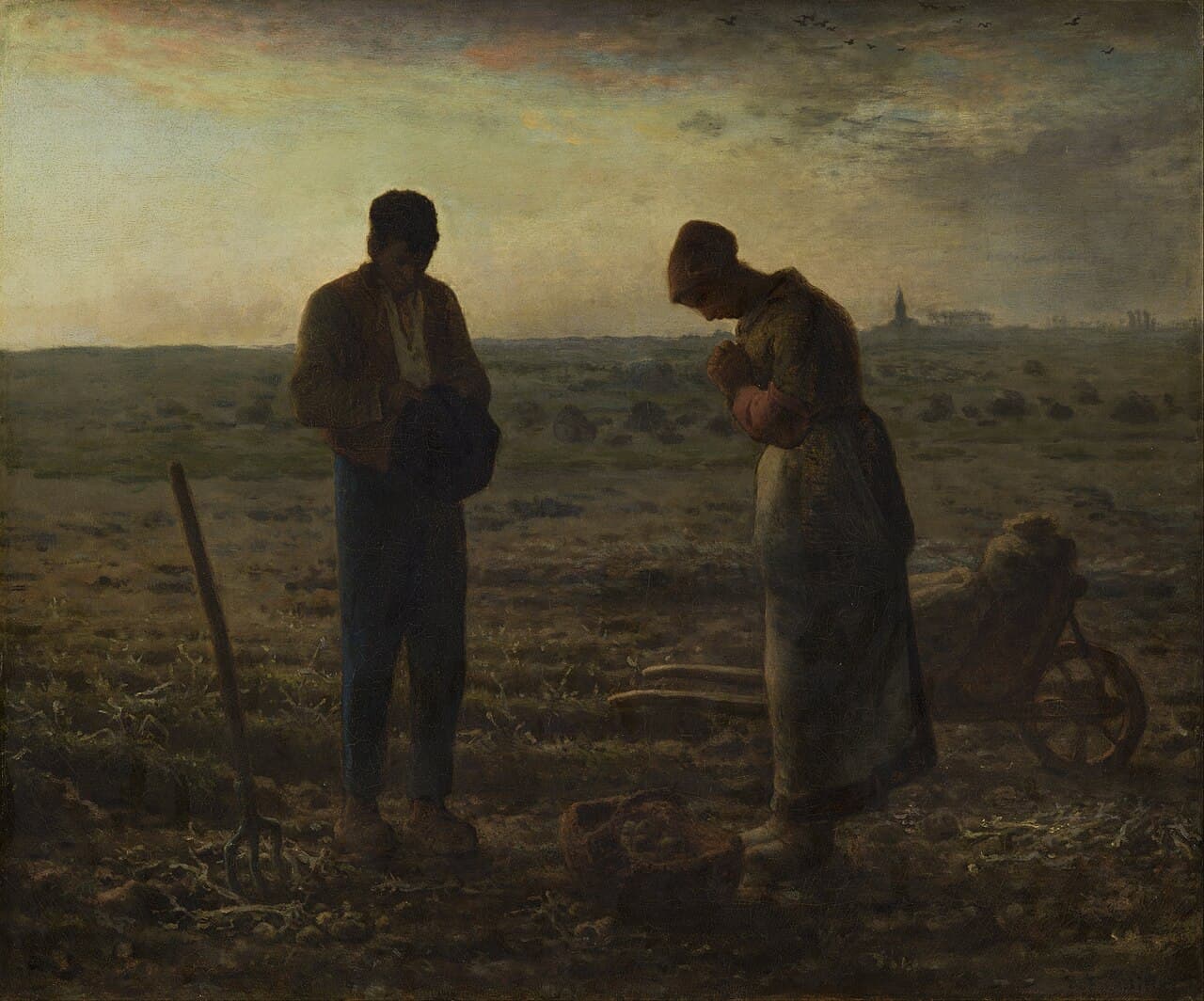
Millet finished the scene of two peasants bowing over a basket of potatoes to say the evening prayer around 1859. In 1860 it sold for 1,000 francs; by 1881 a collector paid 168,000. Millet died in 1875, and the big money came after him. At the Secretan sale in Paris in 1889, the Louvre and the American Art Association fought a bidding war that pushed the price to 553,000 francs, and a year later the Americans resold it for 750,000. A month after that 1889 sale, Millet's The Gleaners fetched 300,000 francs. Meanwhile, the artist's family lived in poverty.
That contrast helped push France to propose droit de suite around 1893, alongside other worries: the salon mattered less, private patrons were disappearing, and the "starving artist" needed defending. France made it law in 1920, seemingly because so many artists and their families had suffered in the First World War. The Berne Convention of 1971 later recognised the same principle, and an EU directive in 2001 required a fairly uniform version across the European Union. It remains debated: in the French Parliament, critics argued that the fee is in practice paid only at auctions and so disadvantages Paris compared with London or New York. The United States takes the opposite approach, the first-sale doctrine, under which artists cannot profit from later sales.
Quiz me
0/3
Recap
Where droit de suite exists, an artwork's rising value is shared with its creator or their heirs; under the US first-sale doctrine, it is not.
Surprising fact · The Angelus went from 1,000 francs in 1860 to 750,000 francs in 1890.
Sources (2)
No source, no claim. Every fact in this lesson (18 claims) cites at least one of these.