Why do the English words 'east' and 'west' come from 'dawn' and 'evening'?
'East' and 'Easter' share an ancient root for the dawn, the same root behind the name of a reconstructed dawn goddess.
▶ Start the storyBecause they were named after the sun's daily path. English 'east' comes from an ancient word for dawn and 'west' from a word for evening, and both go back to the same Proto-Indo-European root meaning 'shine (red)'. 'South' is related to the word 'sun' (roughly 'the region of the Sun'), and 'north' comes from a root meaning 'to the left of the rising sun', which is where your left hand points when you face the dawn. These Germanic names later pushed out the Latin words for the compass points in the Romance languages, which is why French nord, sud, est and ouest look like English north, south, east and west.
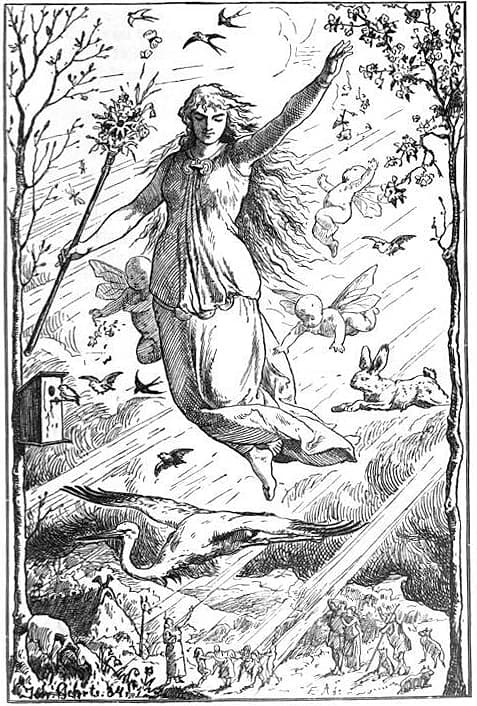
The dawn link goes further: 'east' shares its root with Ēostre, an Anglo-Saxon goddess. The historian Bede wrote that pagan Anglo-Saxons held feasts for her in the month named after her, roughly April, and that this name passed to the Christian feast we call Easter. Scholars once debated whether Bede had invented her, but today most accept she was a genuine pagan goddess, and linguists trace her name back to a Proto-Indo-European goddess of the dawn.
Not every culture organizes space around a compass. In Hawaii and Bali, people make greater use of directions such as toward the sea or toward the mountains. In ancient Egypt, and in the Yurok and Karuk languages of North America, the key axis was upstream and downstream. On Guadalcanal in the Solomon Islands, the Lengo language has four non-compass directions: landward, seaward, upcoast and downcoast.
Some Indigenous Australian groups go the other way: the Guugu Yimithirr people use cardinal directions rather than words like left and right, even for something right next to their body. Other cultures multiply the directions: Chinese tradition ties a five-point system, including the centre, to the I Ching and the five elements, and classical Hindu scripture recognizes ten deities, the Dikpālas, who symbolize ten directions, including up and down.
Quiz me
0/3
Recap
East is the dawn side and west the evening side: both words come from a root meaning 'shine (red)', and many cultures orient themselves by the sea, a river or a mountain instead.
Surprising fact · English 'east' and 'Easter' share the same ancient root for dawn, tied to the Anglo-Saxon goddess Ēostre.
Sources (2)
No source, no claim. Every fact in this lesson (16 claims) cites at least one of these.