Why do AI-generated 'dreams' look psychedelic?
A Google program was run backwards to find animals and faces in any image, and researchers later found that watching its swirling output changes brain activity in ways that resemble psychedelic states.
▶ Start the storyBecause the program lets the patterns it has learned overwrite what is actually in the image, which researchers compare to how hallucinogens let internal expectations dominate what we see. DeepDream, a Google program created by engineer Alexander Mordvintsev, uses a convolutional neural network to find and enhance patterns in images, producing a dream-like look that resembles a psychedelic experience in the deliberately overprocessed results. The trick is that the network, originally trained to recognize faces and animals in photos for a 2014 image-recognition competition, gets run backward: instead of identifying what's in an image, it's told to subtly reshape the image so a chosen feature, say, a face or a certain animal, scores higher and higher. After enough rounds of this, even an image that never contained that feature starts sprouting it everywhere, a glitchy, algorithmic version of looking for animals in clouds.
That comparison to hallucination isn't just poetic. Neural networks like DeepDream have been described as having biological analogies to brain processing, since hallucinogens such as DMT alter a chemical system that sits inside the very layers of the visual cortex responsible for seeing. The idea is that both a dreaming network and a tripping brain are doing something similar: letting internal, preconceived patterns dominate over weak or ambiguous input from outside.
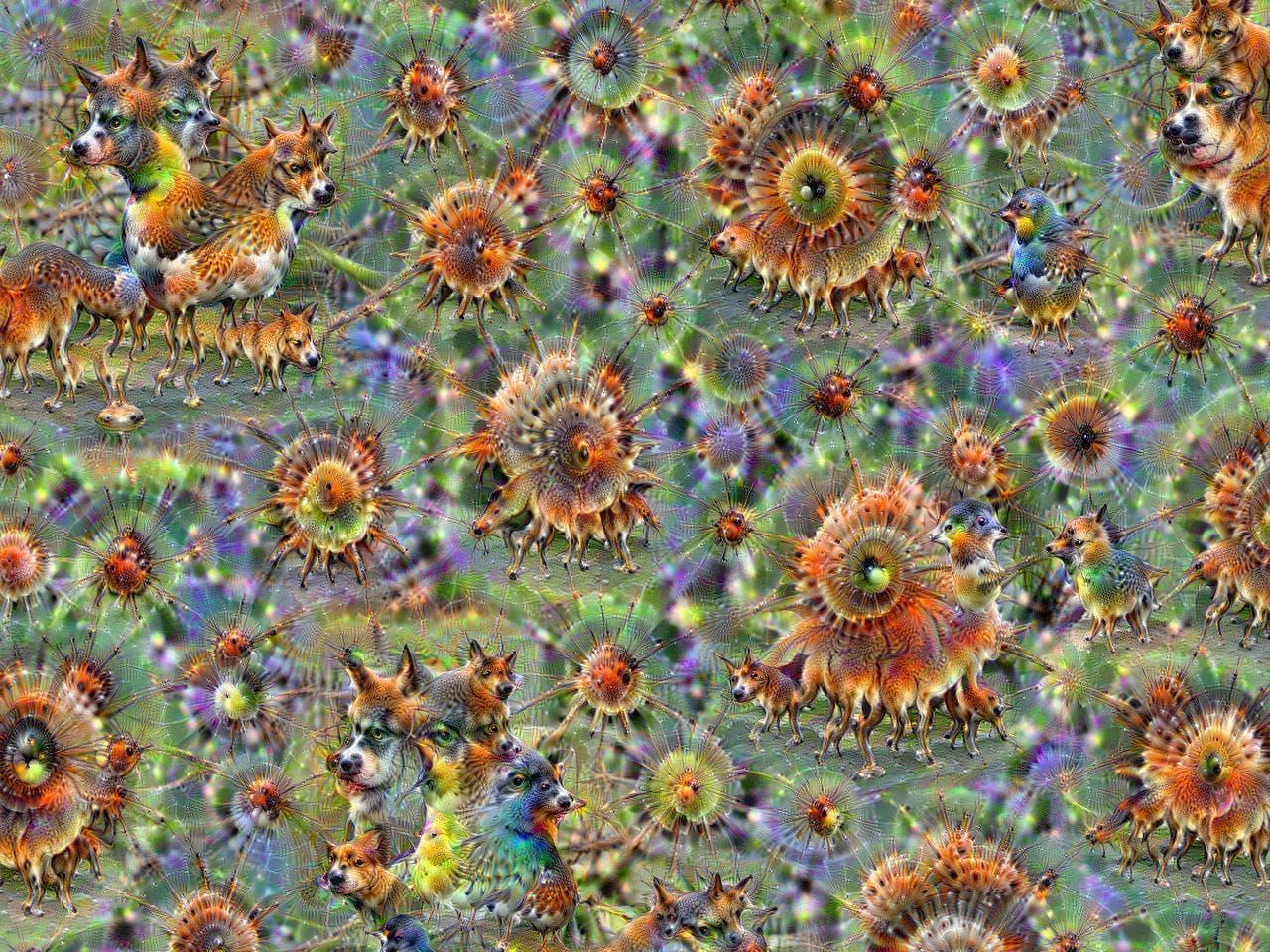
Scientists have actually tested this resemblance rather than just asserting it. In 2017, researchers at the University of Sussex built a 'Hallucination Machine' by running the DeepDream algorithm on panoramic video, and found that people's subjective experience of watching it differed clearly from ordinary video while sharing real similarities with the psychedelic state produced by psilocybin. A 2021 study went further, recording brain activity with EEG while people watched DeepDream-altered footage, and found it triggered higher entropy and more connectivity between brain regions, two signatures that show up during genuine psychedelic experiences. A 2022 study even found that watching DeepDream-style virtual reality footage changed how people made decisions afterward, with automatic processes playing a smaller part in their choices.
None of this proves DeepDream causes a 'real' trip, but it's a striking case of an AI system, built purely to classify photos, accidentally landing on a visual language that genuinely overlaps with how an altered human brain behaves.
Quiz me
0/3
Recap
DeepDream works by running a pattern-recognition network backward, reshaping an image's pixels instead of its internal weights, until the network's own trained expectations take over the picture.
Surprising fact · A 2021 EEG study found DeepDream videos triggered higher brain-signal entropy and connectivity, the same biomarkers seen during actual psychedelic experiences.
Sources (1)
No source, no claim. Every fact in this lesson (15 claims) cites at least one of these.