Where and when did our own species, Homo sapiens, first appear?
A skull pulled out of a Moroccan mine wall in 1961 was first filed away as a Neanderthal. Decades later it pushed the start of our species back by 100,000 years.
▶ Start the storyOur species appeared in Africa at least 300,000 years ago. And probably not in a single spot. That answer is quite new.
For decades, textbooks said Homo sapiens arose in East Africa about 200,000 years ago. The key evidence was the Omo remains from Ethiopia. They were found between 1967 and 1974. The layer beneath them was dated to about 195,000 years.
Then an old, misfiled find forced a rewrite. In 1961, a miner digging for baryte in Morocco pulled a skull from a cave wall at Jebel Irhoud. The stone tools beside it looked Mousterian, a style linked to Neanderthals. So the skull was labelled Neanderthal.
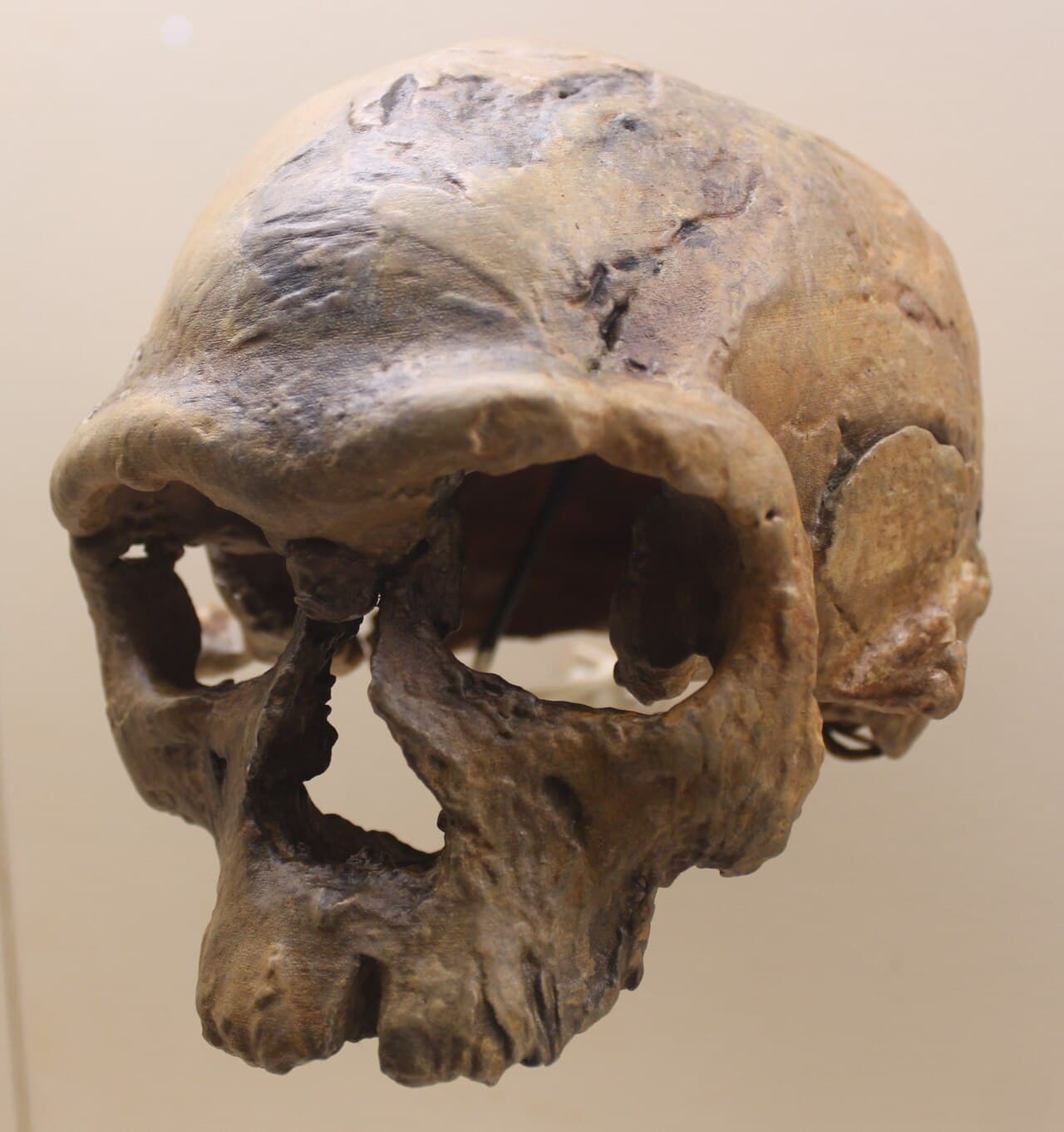
From 2004, Jean-Jacques Hublin's team dug there again. In 2017 they reported an age of about 315,000 years. They also concluded the fossils were early Homo sapiens. The faces look modern, but the braincases are longer than ours. Not everyone has agreed on how to classify them. Recent studies, though, back the early Homo sapiens label.
315,000 years
So early Homo sapiens lived from Morocco to Ethiopia, and in South Africa too. The species likely took shape across Africa, not in one cradle. An older rival idea held that modern humans evolved in many regions at once. In its strong form, that idea has now been abandoned.
Quiz me
0/3
Recap
The 'first Homo sapiens' keeps getting older, and more spread out across Africa, with every well-dated find.
Surprising fact · The Jebel Irhoud skull was filed away as a Neanderthal for decades before 2017 dating showed it was actually the oldest known Homo sapiens.
Sources (3)
No source, no claim. Every fact in this lesson (12 claims) cites at least one of these.