Is a low voice box what lets humans talk?
Our voice box sits unusually low in the throat, which helps us speak. But deer, lions and even your cat lower theirs too, for a very different reason.
▶ Start the storyPartly, but it's not the whole story, and it may not even be why the voice box dropped. In humans the larynx sits lower in the throat than in other primates. That gives us a longer pharynx, the space above the voice box, which increases the range and clarity of the sounds we can make. Other primates have almost no pharynx. Just as important, our tongue curves down into the throat with it, splitting the vocal tract into two tubes of about equal length that can take the shapes needed for speech sounds.
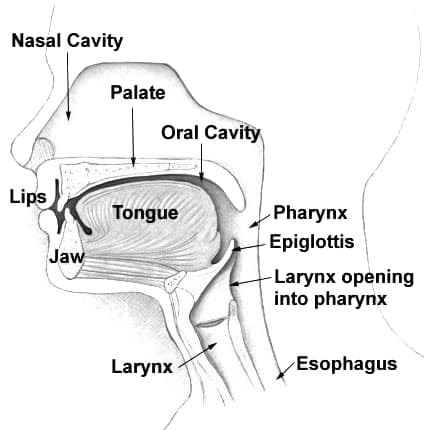
Yet a low voice box isn't unique to us. Goats, dogs, pigs and tamarins drop the larynx briefly to make loud calls. Several deer species have a permanently low larynx, and males pull it lower still when they roar. Lions, jaguars, cheetahs and domestic cats do it too. Lowering the larynx makes a voice sound deeper, giving the impression of a bigger animal. In other species, though, the tongue stays flat in the mouth, so the trick doesn't produce human-like speech.
Step 1: Newborn
Larynx high and forward in the neck
Step 2: Childhood
Larynx descends as the tongue reshapes into the throat
Step 3: Age 6 to 8
The process is complete
Step 4: Puberty, boys only
A second descent deepens the voice
That has led some researchers to argue that our larynx first dropped to make us sound bigger, and only later got recruited for talking. One hint: boys' larynges drop a second time at puberty, girls' don't, yet women outperform men on verbal tests. And speech needs much more than anatomy: no monkey or ape uses its tongue to communicate with sound, and we control our breathing far better than they do.
Quiz me
0/3
Recap
A low voice box helps us talk, but it may have started out as a way to sound bigger.
Surprising fact · Only boys get a second drop of the larynx at puberty, yet women outperform men on verbal tests.
Sources (2)
No source, no claim. Every fact in this lesson (22 claims) cites at least one of these.