How did radio save the Eiffel Tower from demolition?
Paris's most famous monument was built to be temporary, and it survived because it made a great antenna.
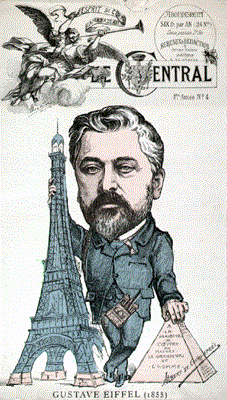
▶ Start the storyThe Eiffel Tower was never meant to last. It was built as a temporary structure for the 1889 World's Fair, and Gustave Eiffel's contract only gave him its income for 20 years. It was scheduled to be dismantled in 1909. What saved it was radio: the tallest structure in the world turned out to be a superb antenna, and its usefulness for radio telegraphy spared it from demolition.
Many Parisians would have been glad to see it go. While it was being built, a committee of artists and writers, including Guy de Maupassant, published a petition imagining a ridiculous tower looming over Paris like a gigantic black smokestack. Maupassant supposedly ate lunch in the tower's restaurant every day, because it was the only place in Paris where he couldn't see it.
Radio quickly proved the tower's worth. A permanent radio centre was built beside it in 1909. From 1910, it sent time signals to ships up to 5,000 km away. In 1914, its transmitter jammed German radio communications during the advance on Paris, helping the Allies win the First Battle of the Marne.
The tower still had close calls. In 1944 Hitler ordered it destroyed along with the rest of Paris, but the German commander disobeyed. Today it still broadcasts radio and television, more than a century after its planned demolition date.
1887
Artists' petition against the tower
1889
Opens for the World's Fair, as a temporary structure
1909
Planned dismantling; permanent radio centre built instead
1910
Daily time signals to ships up to 5,000 km away
1914
Jams German radio before the Battle of the Marne
1944
Hitler orders its demolition; the order is disobeyed
Quiz me
0/3
Recap
The tower the artists wanted gone was saved because it was useful: it became Paris's giant antenna.
Surprising fact · In 1910 measurements at the top of the tower led to the discovery of what we now call cosmic rays.
Sources (1)
No source, no claim. Every fact in this lesson (16 claims) cites at least one of these.