How do skyscrapers survive strong winds?
Many tall towers sway by more than a metre, and some hang a giant steel ball near the top to fight back.
▶ Start the storySkyscrapers survive strong winds not by standing perfectly still but by swaying safely, and by fighting their own motion. Wind can push the top of a tall tower more than a metre sideways; the Burj Khalifa's tip sways a total of 1.5 metres. The real danger is when gusts push in rhythm with the building's natural sway, and the motion builds up, which can also make the people inside feel seasick.
Engineers attack this in two ways. The first is shape. The Burj Khalifa narrows as it rises through 27 setbacks arranged in a spiral, placed so that the wind can't form the regular swirls, or vortices, that would rock the tower.
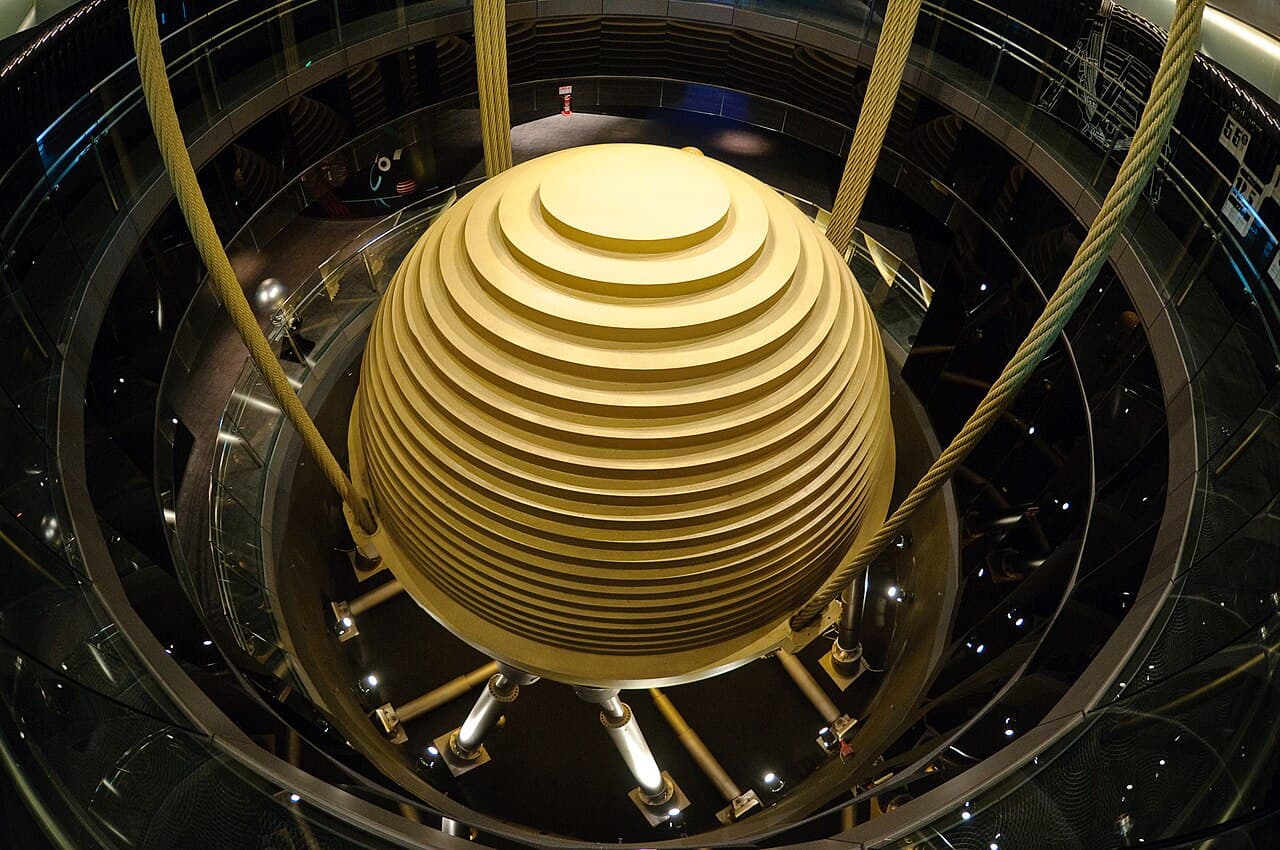
The second is a counterweight that moves. A tuned mass damper is a huge mass hung or mounted on springs near the top, tuned to the building's own rhythm, so that it swings against the sway and soaks it up. Taipei 101's is a 660-tonne steel ball hanging from the 92nd to the 88th floor. It can cut the tower's movement by up to 40%, and in 2015 a typhoon swung it a full metre. It became so popular with visitors that it now has its own cartoon mascot, the Damper Baby.
Step 1: Gusts push
The tower starts to sway at its natural rhythm
Step 2: Mass lags
The damper, tuned to the same rhythm, swings the opposite way
Step 3: Push back
It pulls against the sway, absorbing the motion
Step 4: Calmer top
Maximum sway drops (up to 40% in Taipei 101)
Getting this wrong is frightening: in 1978 a student's thesis helped reveal that New York's Citicorp Center might not survive a strong diagonal wind.
Quiz me
0/3
Recap
Skyscrapers don't stand still: they sway, and engineers tame the sway with smart shapes and swinging counterweights.
Surprising fact · A student's thesis helped expose a possible wind weakness in New York's Citicorp Center, which was secretly reinforced at night in 1978.
Sources (4)
No source, no claim. Every fact in this lesson (16 claims) cites at least one of these.