How did scientists finally prove that continents move?
The man who said continents drift died on the Greenland ice decades before anyone believed him, and the proof was hiding in magnetic stripes on the seafloor.
▶ Start the storyScientists finally proved the continents move by reading the ocean floor, which turned out to be a tape recorder. New seafloor forms at the mid-ocean ridges, and as its rock cools it records the direction of the Earth's magnetic field, which flips every so often. If the seafloor really spreads out from the ridges, the rocks on either side should carry matching stripes of normal and reversed magnetism. In 1963 geophysicists predicted exactly that, and the surveys showed it: the stripes on one side of a ridge are a mirror image of those on the other. By the late 1960s, plate tectonics was accepted.
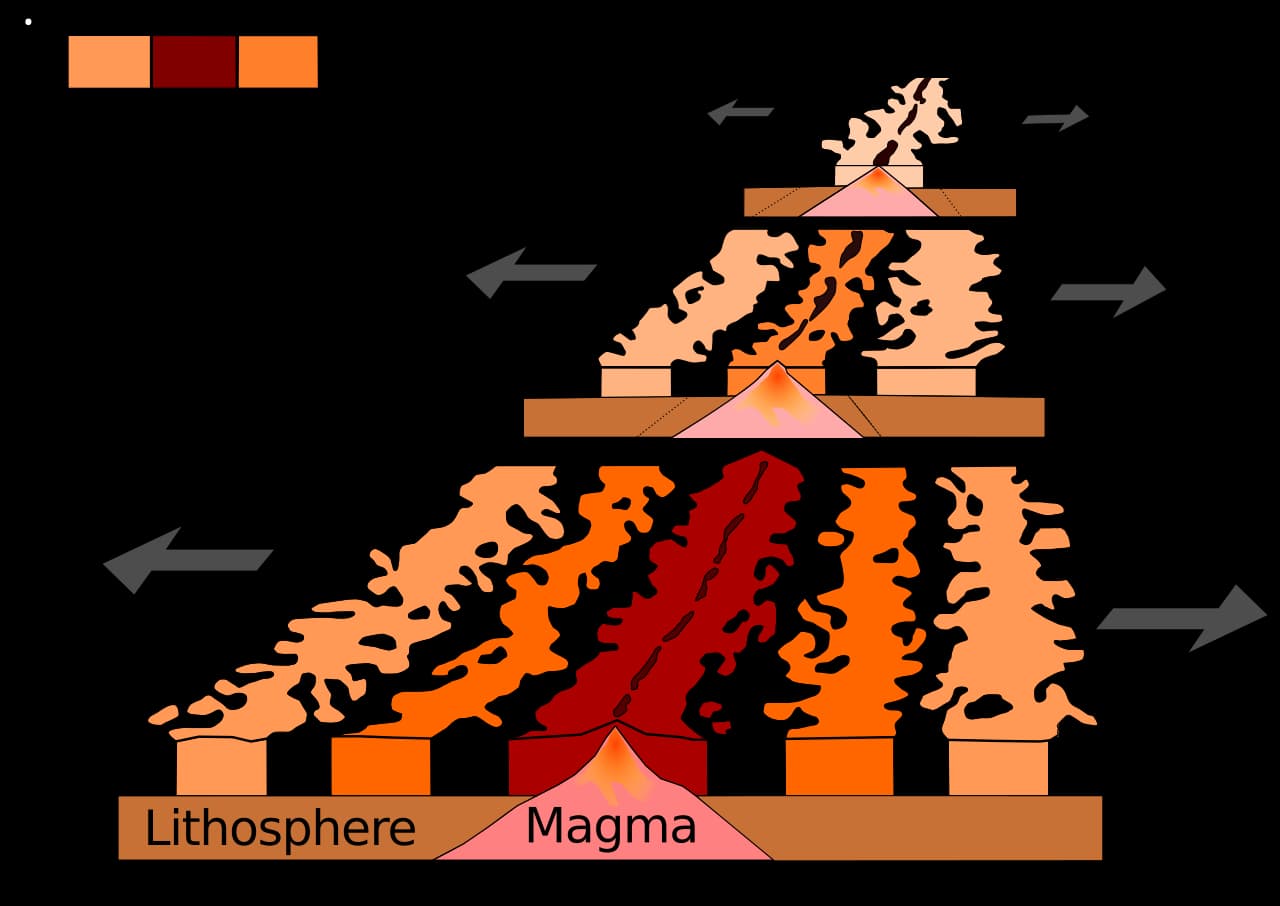
The idea itself was half a century older. On 6 January 1912, the German meteorologist Alfred Wegener proposed that the continents had once formed a single landmass, Pangaea, and had drifted apart. He had good clues, such as fossils of the same freshwater reptile in both Brazil and South Africa. But he couldn't explain what moved continents, and his estimate of 250 cm a year was wildly too fast; the real figure for the Atlantic is about 2.5 cm, roughly the speed your fingernails grow. The theory was rejected for decades, and Wegener died on the Greenland ice sheet in 1930 without seeing it win.
Part of the proof came from a woman who wasn't allowed on the ships. Marie Tharp drew ocean-floor maps from data her colleague Bruce Heezen collected at sea, and spotted a rift valley running down the Mid-Atlantic Ridge. Heezen at first dismissed it as 'girl talk'. She was right.
Quiz me
0/3
Recap
Mirror-image magnetic stripes on both sides of mid-ocean ridges proved the seafloor spreads, and with it that continents move.
Surprising fact · Wegener thought continents moved 250 cm a year; the Atlantic actually widens about 2.5 cm a year, like a fingernail growing.
Sources (6)
No source, no claim. Every fact in this lesson (26 claims) cites at least one of these.