How did Gothic cathedrals get so tall?
Medieval builders moved the walls' hardest job outside the building, onto stone arms that leap through the air.
▶ Start the storyGothic cathedrals got so tall because their builders found a way to take the sideways push of a stone ceiling off the walls and hand it to supports standing outside the building: the flying buttress.
A stone vault doesn't just press down, it also pushes the walls outwards. In earlier Romanesque churches, walls had to be very thick to resist this, and windows stayed small or absent. Gothic builders attacked the problem from three sides. Pointed arches exert less sideways thrust. Rib vaults, a skeleton of stone ribs filled with thin panels, made the ceiling much lighter. And flying buttresses, arches that leap from the upper wall across open air to a heavy pier, carried what thrust remained down to the ground.
Freed from that job, walls could be thinner, higher and full of stained glass. Notre-Dame de Paris got some of the earliest flying buttresses, in 1180. Heights climbed quickly: from 22 metres at Durham to 35 at Notre-Dame, 42.3 at Amiens and 47.5 metres at Beauvais.
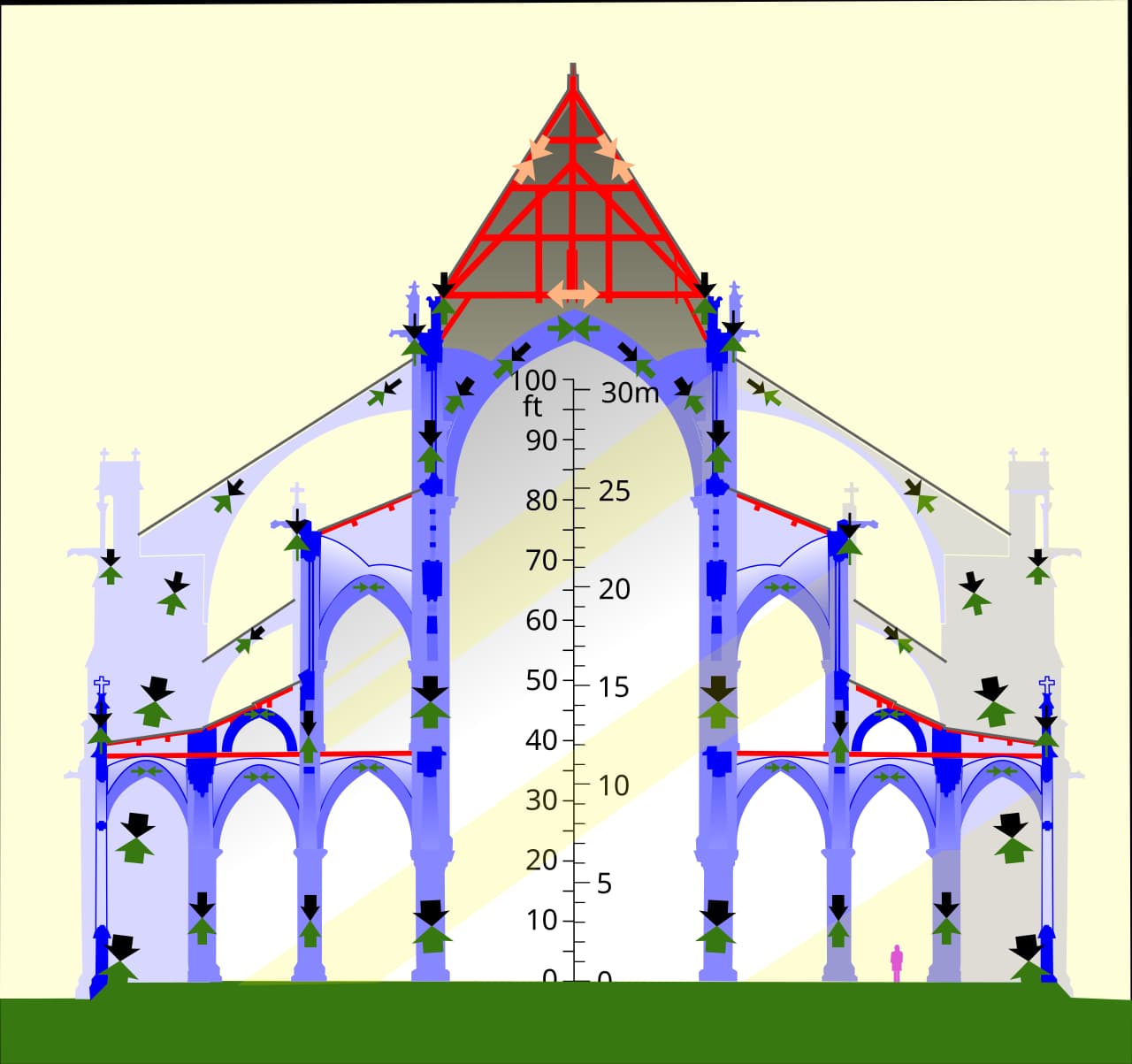
Beauvais shows where the limit lay. Its builders added extra height and made the buttresses thinner to let in more light. In 1284 part of the vault collapsed, probably shaken by resonant vibrations from high winds. The cathedral was never finished.
The race for height
| Height of the vault | |
|---|---|
| Durham | 22 m |
| Notre-Dame | 35 m |
| Amiens | 42.3 m |
| Beauvais | 47.5 m |
Quiz me
0/3
Recap
Lighter ceilings, gentler arches, and the push sent outside: that's how Gothic churches reached for the sky.
Surprising fact · Beauvais pushed its vault to 47.5 metres with thinner buttresses, and part of it collapsed in 1284.
Connects to
- 🌈 Why did Gothic cathedral walls dissolve into colored glass?
- ⛪ How did a ribbed stone ceiling help Gothic walls turn into windows?
- 🔥 How did Notre-Dame survive revolution, near-arson, and a catastrophic fire?
- 🎶 Why does a swing go higher only when you push at the right moment?
- 🌉 How can a pile of loose stones stand up as an arch?
Sources (3)
No source, no claim. Every fact in this lesson (16 claims) cites at least one of these.