How did Descartes think an immaterial mind moves a body?
In 1643 a princess wrote to Descartes with the question his philosophy struggled to answer: if the mind is only a thinking thing, how does it ever make the body move?
▶ Start the storyDescartes thought an immaterial mind moves a physical body through one tiny, specific gland: the pineal gland, a small structure at the center of the brain, between its two hemispheres, which he proposed as the exact point where spirit meets flesh. He believed the mind is a nonphysical, non-spatial substance, something identical with consciousness and self-awareness and entirely distinct from the physical brain, and he was the first documented Western philosopher to formulate the mind-body problem in the form it still takes today.
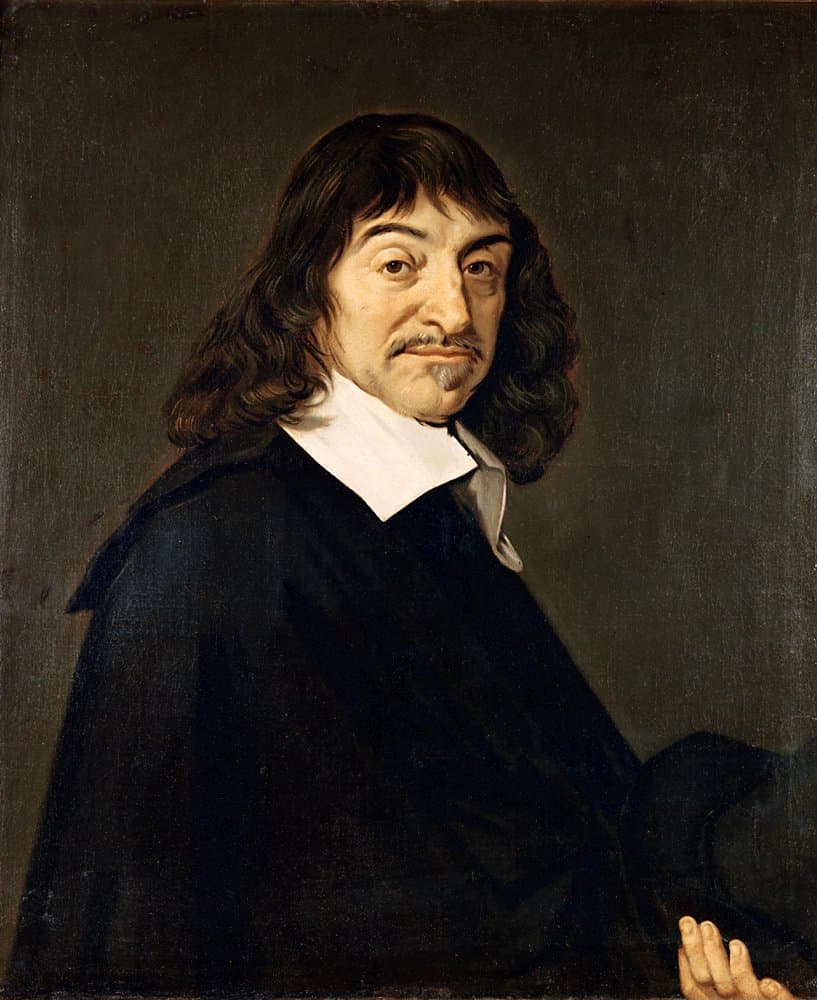
But naming a meeting point didn't solve the deeper puzzle, and Princess Elisabeth of Bohemia pressed him on exactly that. In a letter of May 1643 she asked him how the soul, being only a thinking substance, could move the body's spirits and so produce voluntary actions; unsatisfied with his reply, she wrote again. If mind and body are two totally different kinds of substance, mental and physical, how can an immaterial mind cause anything in a material body, and vice versa? This became known as the problem of interactionism, and Descartes' own answer, that it happens at the pineal gland, didn't really explain anything: it just relocated the mystery to a smaller piece of tissue, since an immaterial mind still had to somehow interact with that physical gland.
The theory was so hard to defend that some of Descartes' own followers, like Arnold Geulincx and Nicolas Malebranche, gave up on direct interaction entirely. They proposed instead that mind and body never really act on each other at all; rather, every apparent interaction is an occasion for God to intervene directly, coordinating the two without either one ever truly touching the other.
This split between mind and body wasn't new with Descartes, only sharpened by him. Aristotle had already held that the souls tied to the body perish at death but an immortal, reasoning part endures, while Plato went further, believing the soul could migrate into a new body entirely. And the split didn't end with the philosophers: dualism became biomedicine's working model for three centuries after Descartes, and traces of it still linger today. Some researchers studying pain argue that splitting it into 'physical' and 'psychological' categories reflects outdated dualistic thinking and can lead to worse care, and a study on epilepsy in Saudi Arabia found that people who saw the condition as spiritual or psychological, rather than neurological, were more likely to stigmatize those who had it.
Quiz me
0/3
Recap
Naming where mind meets body, as Descartes did with the pineal gland, is not the same as explaining how an immaterial thing could ever cause a physical one to move.
Surprising fact · Some of Descartes' own followers decided mind and body never really act on each other, and that God intervenes every time to make it look as if they do.
Sources (2)
No source, no claim. Every fact in this lesson (17 claims) cites at least one of these.