How did a bacterial immune system become a tool for editing human genes?
Bacteria keep mugshots of the viruses that attacked them, filed in their own DNA. Biologists borrowed the system, and in 2023 it was approved as a treatment for sickle-cell disease.
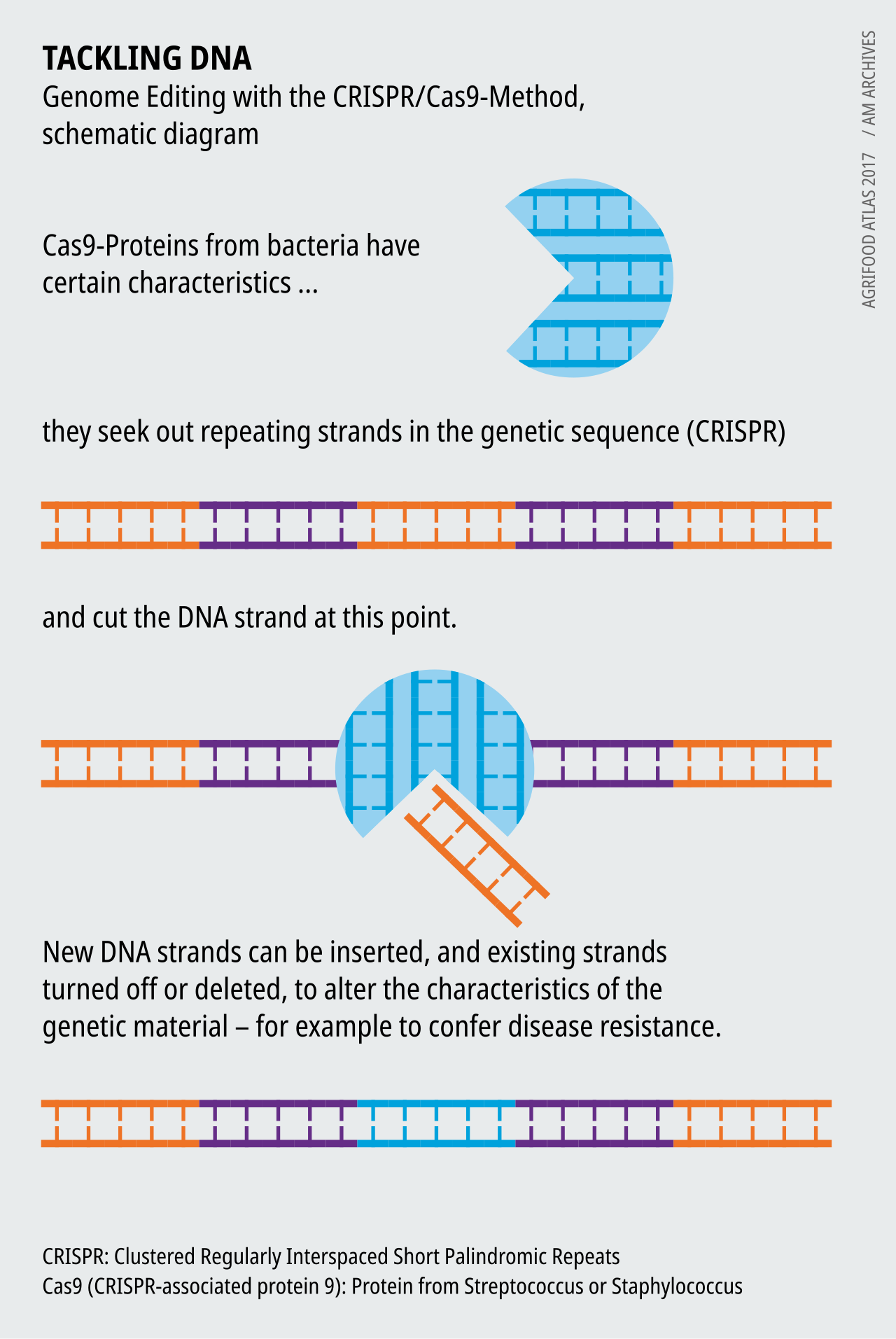
▶ Start the storyBy swapping one guide for another. In bacteria, CRISPR is a memory bank: stretches of DNA that store fragments of viruses that attacked the cell or its ancestors. The bacterium copies those fragments into short guide RNAs, and an enzyme such as Cas9 carries each guide around like a mugshot. When Cas9 finds DNA that matches its 20-letter guide, it cuts it, destroying the invading virus. In 2012 Jennifer Doudna and Emmanuelle Charpentier showed that you can write your own guide: give Cas9 a guide matching any stretch of DNA, and it cuts there. The cell's repair machinery then patches the break, which lets scientists switch genes off, remove them or insert new ones.
The discovery took a long detour through basic curiosity. In the 1990s a Spanish microbiologist, Francisco Mojica, puzzled over strange repeated sequences in microbes called Haloferax and Haloarcula, and in 2001 he and Ruud Jansen named them CRISPR. In 2003 Mojica proposed they were an immune system. Nature and several other top journals rejected the paper; it finally appeared in 2005. In 2007, experiments on Streptococcus thermophilus proved him right: the bacterium added pieces of an attacking virus to its CRISPR and became resistant.
From there it moved fast. Human cells were edited in 2013, and Doudna and Charpentier won the 2020 Nobel Prize in Chemistry. In 2023 Casgevy, which edits a patient's own blood stem cells to boost fetal haemoglobin, was approved in the UK and the US for sickle-cell disease and beta thalassemia, the first CRISPR-Cas9 therapy cleared by the US regulator. In its trial, 29 of 31 sickle-cell patients went a year or more without a severe pain crisis.
The power cuts both ways. In 2018 He Jiankui announced the first gene-edited babies, and was later jailed for three years.
Quiz me
0/3
Recap
Guide finds, Cas9 cuts, the cell repairs: change the guide and you change where the cut lands.
Surprising fact · Bacteria were using CRISPR to remember viruses long before humans existed; the first paper saying so was rejected by Nature.
Sources (6)
No source, no claim. Every fact in this lesson (34 claims) cites at least one of these.