How does a central bank change one interest rate and cool down a whole economy?
A committee nudges the rate banks charge each other overnight, and months later mortgages, hiring and prices all feel it.
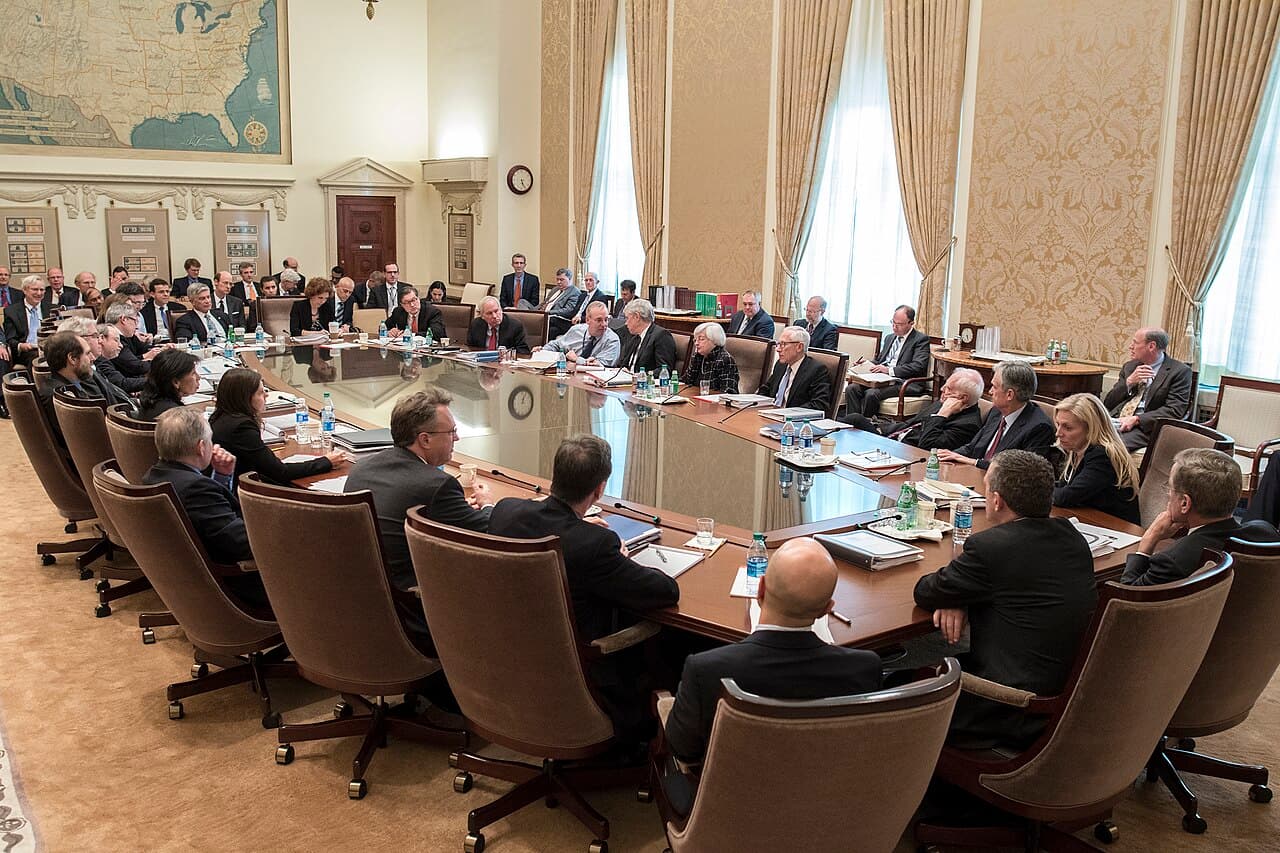
▶ Start the storyIt sets the price of the very shortest loans, and that price ripples outwards. Banks constantly lend each other money overnight. A central bank fixes a target for that overnight rate and enforces it: it always lends to banks at the top of a band and pays them on deposits at the bottom, so no bank will pay more or accept less. In the US this is the federal funds rate, set by a committee that normally meets eight times a year.
From there the change spreads. When the policy rate rises, banks charge more on loans to firms and households. Businesses borrow and spend less, including on hiring, so household incomes and spending fall too. Higher rates also tend to lower stock and house prices, so owners feel poorer and spend less, and they shift exchange rates, which affects exports. Less overall demand means less pressure on prices: inflation cools, though jobs suffer too.
None of this happens instantly, and much of it runs on expectations. Because people's beliefs about future inflation shape actual inflation, central banks have to be credible. Most aim for a target, often 2%.
Step 1: Policy rate up
The central bank raises its target for overnight lending between banks.
Step 2: Loans get dearer
Banks charge firms and households more to borrow.
Step 3: Spending and hiring fall
Firms cut investment and labour; households spend less.
Step 4: Assets and currency move
House and stock prices dip; the exchange rate shifts.
Step 5: Demand and inflation cool
Less overall demand means less pressure on prices, and on jobs.
The most dramatic demonstration came from Paul Volcker. As head of the US Federal Reserve, he pushed the federal funds rate to 20% in 1981. Inflation, which had peaked at 14.8% in 1980, fell below 3% by 1983, but at the cost of a recession, unemployment over 10%, and farmers blockading the Fed with their tractors.
Quiz me
0/3
Recap
Higher policy rate → dearer loans → less spending → less demand → lower inflation, but fewer jobs too.
Surprising fact · New Zealand was the first country to adopt an official inflation target, in 1990.
Sources (4)
No source, no claim. Every fact in this lesson (31 claims) cites at least one of these.