Does your brain secretly slow you down before your muscles actually run out?
A Nobel Prize winner proposed in 1924 that the body has a hidden 'governor' protecting the heart during exercise. The idea was disregarded for 73 years, until a sports scientist revived it.
▶ Start the storyMaybe. One contested theory in sports science says yes: that the brain deliberately throttles your muscles before they're actually spent, as a built-in safety margin, and that the exhaustion you feel is that throttle, not your tank running dry. This idea is called the central governor, and it proposes that the brain continuously calculates a 'safe' level of exertion and limits exercise by reducing how many muscle fibers it recruits, which is experienced, subjectively, as fatigue.
The idea has a surprisingly old pedigree. Archibald Hill, who won the Nobel Prize in Physiology or Medicine in 1922, proposed something similar back in 1924: a 'governor' that protected the heart from oxygen starvation during intense exercise by slowing circulation before things got dangerous. Scientists largely ignored this for decades, instead explaining fatigue as a simple mechanical failure in the muscles themselves, caused by too little oxygen, a buildup of lactic acid, or running out of fuel entirely. It wasn't until 1997 that sports scientist Tim Noakes revived Hill's old idea, proposing with colleagues that the brain continuously adjusts muscle power output based on a running calculation of safe exertion, factoring in past experience, how long the effort is planned to last, and the body's current state, all happening below the level of conscious awareness.
Central governor
- Brain limits muscle recruitment to protect the heart
- Fatigue is a protective brain signal
- Supported by placebo performance effects
Peripheral failure
- Muscles fail mechanically
- Low oxygen, lactic acid, or fuel loss
- The long-dominant explanation
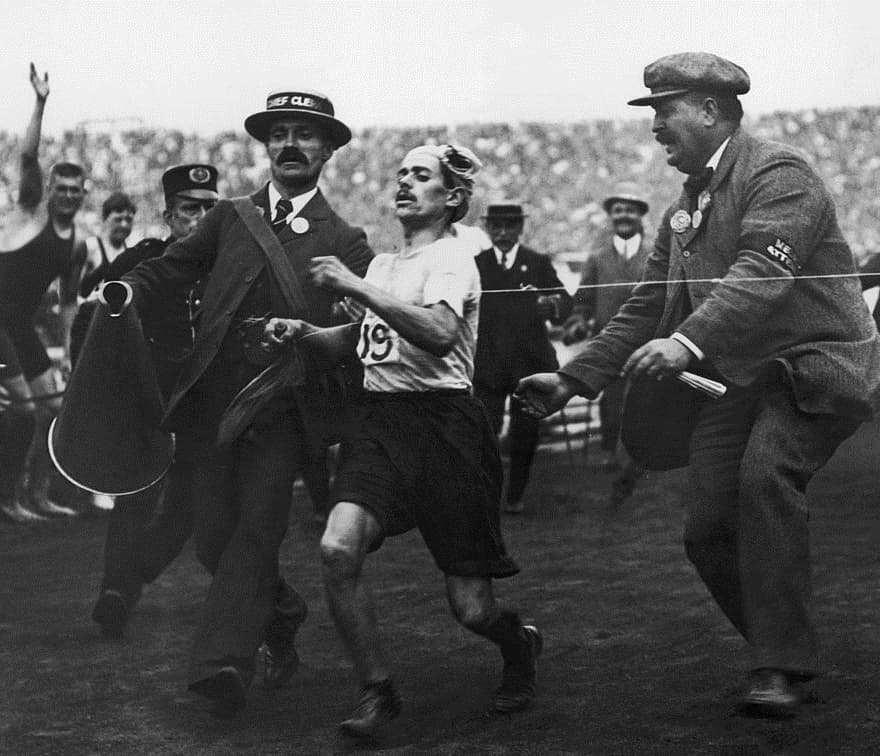
One of the stranger pieces of evidence for this theory comes from something that should have nothing to do with muscles at all: placebos. A fake treatment, with no actual physical effect, has a powerful effect on sprint speed, the heaviest leg-extension lift, and tolerance of pain. Since a placebo must work through the brain, supporters argue this shows something central, not the muscle alone, is setting the limit. Still, the theory has real critics. Famous marathon collapses, such as those of Dorando Pietri, Jim Peters and Gabriela Andersen-Schiess, show that 'physiological catastrophes' do happen, which suggests that people can sometimes override whatever safety brake the brain is applying, which is exactly the kind of evidence skeptics point to against the idea.
Quiz me
0/3
Recap
Feeling like you can't go on doesn't always mean your muscles are empty; it might mean your brain has decided you've reached its idea of a safe limit.
Surprising fact · Placebos, which must act through the brain, have a powerful effect on sprint speed, leg-extension strength and pain tolerance.
Sources (1)
No source, no claim. Every fact in this lesson (10 claims) cites at least one of these.